
Wellbeing at St Thomas'
Over the course of their education, children spend over 7,800 hours at school. With such a huge amount of time spent in the classroom, schools provide an ideal environment for promoting good emotional wellbeing and identifying early behaviour changes and signs of mental distress. The social and emotional skills, knowledge and behaviours that young people learn in the classroom can help them to build resilience and set the pattern for how they will manage their mental health throughout their lives. Emotional wellbeing is a clear indicator of academic achievement, success and satisfaction in later life. Evidence shows that mental health and wellbeing programmes in schools, can lead to significant improvements in children’s mental health, and social and emotional skills. Wellbeing provision in schools can also lead to reductions in classroom misbehaviour and bullying.
Please click on the link to view our Emotional Health and Wellbeing Policy.

Health and Wellbeing Useful Information Directory
Please use the link to visit this page.
Well-Being Provision at St. Thomas’ Leesfield
|
Universal |
Selected |
Targeted |
|
Adjustments, interventions and support accessible to all children. |
Stage 1 – support and interventions delivered using the school’s resources and led by a staff member. Stage 2 – as above but including the support of external professional through consultation. |
Support and interventions for children who have more complex and enduring emotional or mental health needs. |
|
|
|
For our staff (adults) we:
- Support eachother daily, informally
- Share ideas, planning, resources in school and with other schools (DLP/Saddleworth & Lees Collaborative)
- Have ‘coaching’ available from our own trained staff
- Planned staff wellbeing activities
- Meals together and also with the children
- Social time together
- Pay It Forward
- Christmas Dinner celebrations & Secret Santa
- Birthday celebrations – milestone years!
- Through our payroll provider Supply Cover Scheme (SAS) access to a huge range of preventative therapies including counselling, physiotherapy etc
- Through our LA Employee Assistance Programme (EAP) access to counsellors/support network and other professionals
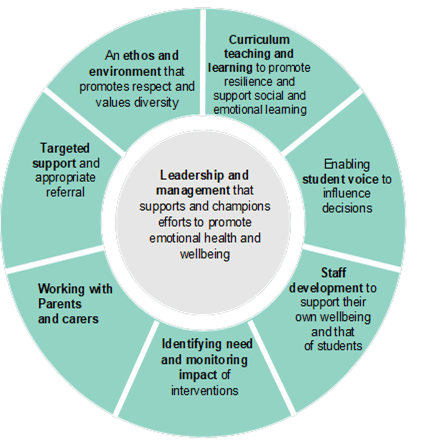
Eight principles to promote emotional health and wellbeing in schools
- Leadership and management - That supports and champions efforts to promote emotional health and wellbeing.
- Ethos and environment - that promotes respect and values diversity.
- Curriculum teaching and learning - to promote resilience and support social and emotional learning.
- Targeted support - and appropriate referral.
- Working with parents/ carers.
- Identifying need and monitoring impact of interventions.
- Staff development - to support their own wellbeing and that of students.
- Enabling student voice to influence decisions.
Five Ways to Wellbeing
Connect: Spend time with family and friends. Enjoy doing things together and talking to each other.
Be active: It keeps you physically healthy, and makes you feel good
Keep learning: Try something new. Try a new hobby, or learn about something just because it interests you.
Take notice: Take a break to see how you feel. Relax and look around you or listen to music, take a few deep breaths.
Give: Do something for a friend or relation/adult, as well as making them feel good, it can make you feel good too!


Step 1 - Connect
Connecting with others can help us feel close to people, and valued for who we are. Being social means different things for different people – you might prefer being in quieter situations with one other person, or you might like being in big groups. You might like to connect with people online, or you might enjoy phone calls or sending letters.
Here are some ways you could make a connection today:
- If you feel comfortable, you could try speaking to someone new
- Ask how someone’s weekend was, and really listen when they tell you
- Put 5 minutes aside to find out how a colleague is doing
- Give a colleague a lift to work or share the journey home with them
Step 2 - Get Active
Many people find that physical activity helps them maintain positive mental health.
This doesn't have to mean running marathons or training every day at the gym. There are lots of different things you can do to be a bit more active.
Studies have shown that getting active can help you sleep better, have happier moods, and reduce feelings of stress, anxiety and racing thoughts.
Here are a few ideas for how you can get active today:
- Take the stairs rather than the lift
- Go for a walk at lunchtime
- Walk into work – maybe you could go with a colleague
- Get off the bus a stop earlier than usual and walk the final part of your journey to work
- Organise a work sporting activity
- Have a kick-about in a local park
- Do some stretches before you leave for work in the morning
- If you're in the office, walk over to someone’s desk instead of calling or emailing
Step 3 - Take Notice
Reminding yourself to take notice can help you to be aware of how you're feeling. It can help you understand what triggers your feelings of stress or anxiety.
Some studies have shown that savouring ‘the moment’ can also help you to feel more positive about life.
Take some time to enjoy the moment and the environment around you. Here are a few ideas:
- Get a plant for your workspace
- Have a ‘clear the clutter’ day
- Take a different route on your journey to or from work
- Visit a new place for lunch
Step 4 - Learn
We're always learning new things – often without realising it. Feeling like you're learning and developing can boost your self-esteem.
And sometimes, setting goals can help you to feel more productive and more in control of your life.
What can you learn today? Here are a few ideas:
- Find out something about your colleagues
- Sign up for a class
- Read the news or a book
- Set up a book club
- Do a crossword or Sudoku
- Research something you’ve always wondered about
- Learn a new word
Step 5 - Give
There's been lots of research about the effects of taking part in social and community life. Some studies have shown that people who help others are more likely to rate themselves as happy.
Is there anything you can do today, to be kind or helpful to someone else? You could try:
- Making a cup of tea for a colleague
- Offering to help a colleague with something they're stuck on
- Introducing yourself to a new-starter, to help them feel more at ease
- Seeing if there are any volunteering initiatives open at work
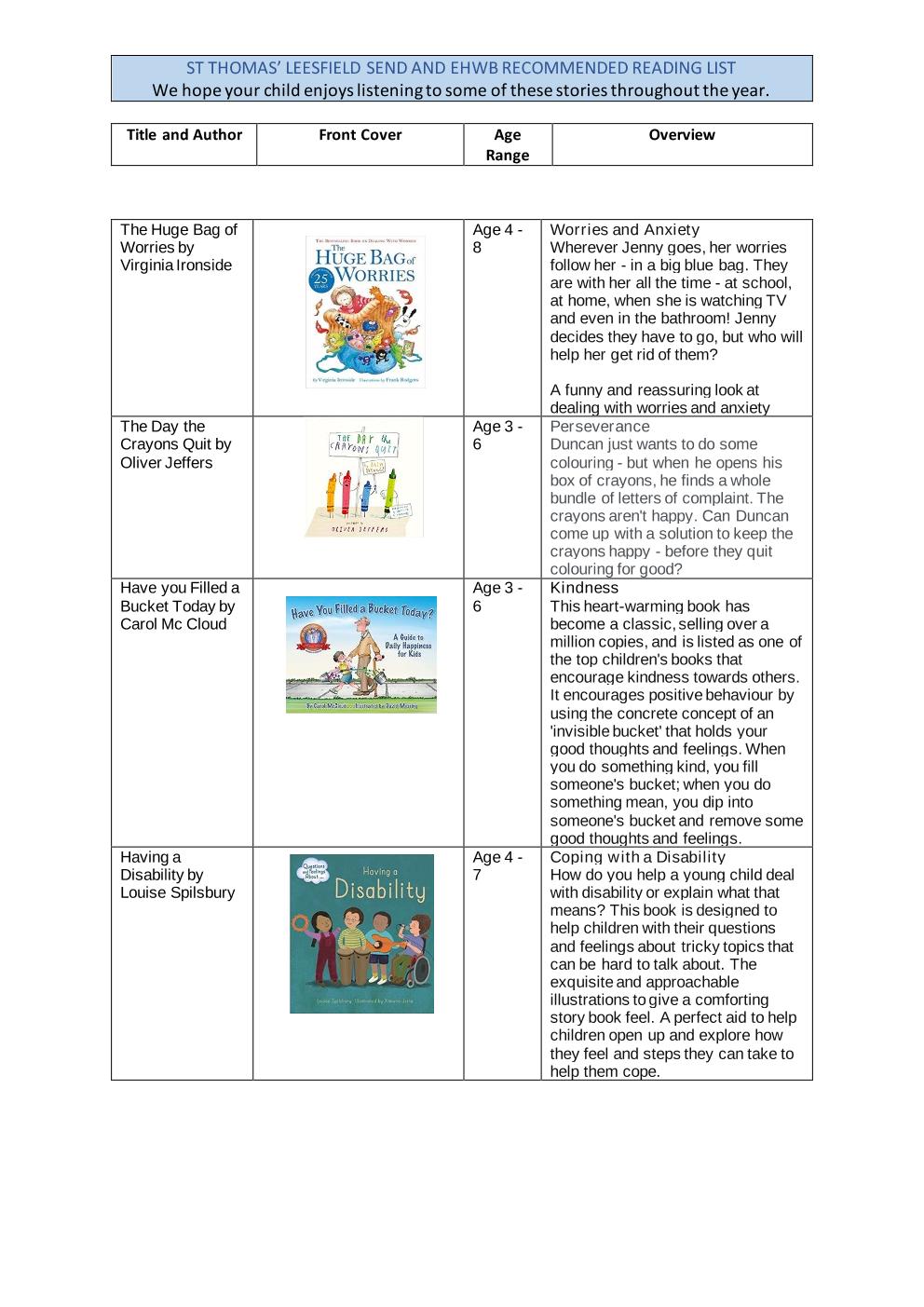
Mental Health and Wellbeing
The last year has been extra stressful, especially if you’re a parent. It's normal and entirely understandable if you're feeling overwhelmed frustrated, worried or exhausted about the situation.
You might be finding it harder than ever at the moment to know how to best look after your child’s mental health and wellbeing, as well as your own. If you’re struggling, you are not alone. Here are some resources that can really help. Please click on the picture link.

|
ST THOMAS LEESFIELD SEND and EHWB RECOMMENDED READING LIST | [pdf 600KB] |

|